

Introduction
Starting a new business in Singapore is exciting, but it also comes with financial challenges.
Many first-time entrepreneurs struggle to secure enough funding to cover equipment, inventory, staffing, and day-to-day operations. Managing cash flow while trying to grow may be overwhelming, especially when personal savings or family support aren’t enough to sustain the venture.
A startup business loan helps bridge the gap between ideas and execution, providing the capital entrepreneurs need to launch and grow. Whether you are developing a digital platform, opening a retail outlet, or starting a service-based company, early access to funding can determine how quickly and sustainably you scale.
Partnering with a licensed money lender in Singapore ensures safe, legal, and flexible access to funds under the Ministry of Law’s regulations. In Singapore’s regulated lending environment, working with a compliant lender protects you from hidden fees, unclear terms, or illegal practices.
This article explains the key funding options available to startups and the eligibility criteria lenders typically require. It also outlines the approval factors and practical steps involved in securing the right startup business loan for your new venture.
Key Takeaways:
- Startup funding supports growth and stability, allowing businesses to invest in product development, operations, and marketing during their early stages.
- A startup business loan can cover essential costs, such as equipment, staffing, inventory, or managing daily cash flow before revenue stabilises.
- Preparing a strong application improves approval chances, including clear funding goals, organised documents, and a realistic business plan.
- Loan approval depends on key financial factors, such as creditworthiness, cash flow stability, debt servicing ratio, and the strength of your business plan.
- Regulated money lenders provide regulated financing options, offering transparent terms and flexible funding solutions for startups in Singapore.
- Responsible loan management builds financial credibility, helping startups strengthen their credit profile and access larger funding opportunities in the future.
Why Funding Is Crucial for Startups
Securing capital at the early stage is not simply about survival. It is about positioning your company for structured growth and long-term sustainability. With the right financial support in place, businesses can focus on establishing a sustainable path toward long-term success.
1. Enables Growth and Scalability
Funding allows startups to expand operations beyond the initial launch phase. With adequate capital, entrepreneurs may increase inventory, hire additional staff, or invest in technology that improves efficiency.
Without sufficient resources, businesses often remain stagnant. A startup business loan can provide the financial support needed to move from proof of concept to stable, revenue-generating operations.
2. Supports Product and Idea Development
Before revenue stabilises, many startups must invest heavily in research, testing, and refinement. Product development, software upgrades, prototyping, and regulatory compliance all require upfront spending.

Entrepreneur funding support enables founders to refine their offerings before entering competitive markets. This early investment often improves customer satisfaction and long-term brand reputation.
3. Drives Marketing and Visibility
Even strong products or services can struggle to succeed without sufficient visibility in the market. For many startups, attracting customers and building brand recognition requires consistent marketing efforts. Activities such as digital marketing campaigns, website optimisation, branding initiatives, and targeted advertising all require financial investment.
Access to SME funding options enables startups to allocate resources toward these marketing efforts at the right time. With adequate funding, businesses can strengthen their online presence, reach their target audience more effectively, and compete in crowded industries. This is particularly important in competitive sectors in Singapore, such as F&B, e-commerce, and professional services, where strong marketing strategies often determine how quickly a new brand gains traction.
4. Provides Strategic Value Beyond Capital
While loans differ from investors in structure, some financing relationships still offer strategic value beyond the funding itself. Experienced lenders who work closely with SMEs often understand the financial challenges that startups face.
By maintaining a transparent relationship with a reliable financing partner, startups may gain not only access to capital but also a clearer understanding of how to manage debt responsibly while supporting sustainable business growth.
5. Attracts Future Investors
Successfully managing a startup business loan can help build financial credibility. When a business demonstrates the ability to borrow responsibly and maintain consistent repayments, it signals reliability and financial discipline.
A positive repayment track record strengthens the company’s financial profile, which may be beneficial when seeking additional funding in the future. A well-managed loan potentially serves as evidence that the business is capable of handling financial obligations and managing growth responsibly.
Types of Startup Funding Options in Singapore
Starting a business often requires more than just a strong idea. Many startups need additional funding to support equipment purchases, inventory, staffing, marketing, or daily operational costs during the early stages of growth.
Different financing options offer different advantages depending on the startup’s business model, financial standing, and urgency of funding needs.
Government-Assisted Schemes
Government-assisted funding schemes are designed to support entrepreneurship, innovation, and business development. In Singapore, startups may explore grants, financing programmes, or support initiatives offered through agencies such as Enterprise Singapore.
These schemes may help businesses offset costs related to expansion, technology adoption, productivity improvements, or overseas growth. Some programmes also work alongside participating financial institutions to improve access to financing for eligible businesses.
However, government-supported schemes often come with eligibility requirements, documentation processes, and assessment periods that startups need to prepare for in advance.
Traditional Bank Loans
Banks remain one of the more common funding sources for startups seeking structured financing solutions. Depending on the business profile, startups may apply for working capital loans, equipment financing, trade financing, or business term loans.
Bank loans may offer comparatively lower interest rates for businesses with stronger financial records, stable revenue, or established operational histories. Some startups may also benefit from government-backed business loan programmes administered through banks.
At the same time, approval requirements can be stricter for newly established businesses without extensive financial records, proven cash flow, or existing credit history. Processing timelines may also be longer due to more detailed assessments and documentation checks.
Alternative and Online Lenders
Alternative financing providers and online lenders have become increasingly common among startups looking for faster and more flexible access to funding.
These lenders often provide streamlined application processes, digital submissions, and quicker approval timelines compared to traditional financing channels. Some startups turn to alternative lenders when immediate operational funding is required or when they may not meet conventional bank lending criteria.
Depending on the lender, financing structures may vary from short-term working capital support to invoice financing or revenue-based repayment arrangements. Startups should still review repayment terms, fees, and borrowing conditions carefully before committing to any financing arrangement.
Licensed Moneylenders
Licensed moneylenders provide another financing option for startups and business owners seeking quicker access to funds. In Singapore, licensed moneylenders operate under regulations governed by the Ministry of Law and must follow legal requirements relating to loan practices, fee structures, and borrower protections.
For some startups, licensed moneylenders may offer a more accessible solution when traditional financing approval timelines are too long or when immediate business expenses need attention. Applications are often processed with fewer documentation requirements and shorter waiting periods.
Before taking up any business-related loan, startups should assess repayment obligations carefully and ensure the financing arrangement aligns with their business cash flow and operational needs.
What Are Startup Business Loans?
A startup business loan is a financing solution designed for new or early-stage businesses that lack long financial histories. Unlike traditional bank loans, these financing arrangements tend to focus more on projected viability than past performance.
In Singapore, startup business loans fall under broader business financing solutions aimed at supporting SMEs and entrepreneurs.
Common purposes include:
- Covering equipment, inventory, or supply purchases
- Paying staff salaries and operating expenses
- Supporting product development or new market expansion
- Managing daily cash flow and seasonal gaps
For example, a founder launching a café may require capital for renovation, kitchen equipment, and supplier deposits, which can be supported through small business loans. Similarly, the loan can help a technology startup to hire developers and build its product before securing its first client contract.
In many cases, entrepreneurs also rely on a working capital loan for startups to maintain liquidity while waiting for receivables. This type of funding ensures that daily obligations such as rent and payroll are met without interruption.
Why Traditional Bank Loans May Not Work for Startups
While banks play an important role in Singapore’s financial ecosystem, their lending criteria are often designed for established businesses with proven financial performance. They typically require:
- 1–2 years of operating history
- Proven and stable revenue
- Strong credit profiles
- Collateral or guarantees
Many new businesses may not be able to meet these criteria. This is because early-stage companies are still testing markets, refining pricing models, and stabilising revenue streams. As a result, some business founders consider alternative financing options, such as working with a legal money lender in Singapore that can offer more flexible assessment criteria.

Unlike banks, certain lenders evaluate projected income, founder credibility, and business plans, instead of relying solely on historical profit data. However, flexibility does not mean lower standards. Responsible lenders still assess repayment ability carefully to minimise over-borrowing.
A small counterpoint to consider is that some alternative financing carries higher interest rates than bank loans due to increased risk exposure. Entrepreneurs should compare costs carefully and ensure projected revenue comfortably supports repayments.
How to Apply for a Startup Business Loan
Securing financing is often one of the first major steps for new businesses. A startup business loan can grant the capital needed to cover operational costs, invest in equipment, and support early growth. Understanding the startup loan application process helps entrepreneurs prepare effectively and improves the chances of approval.
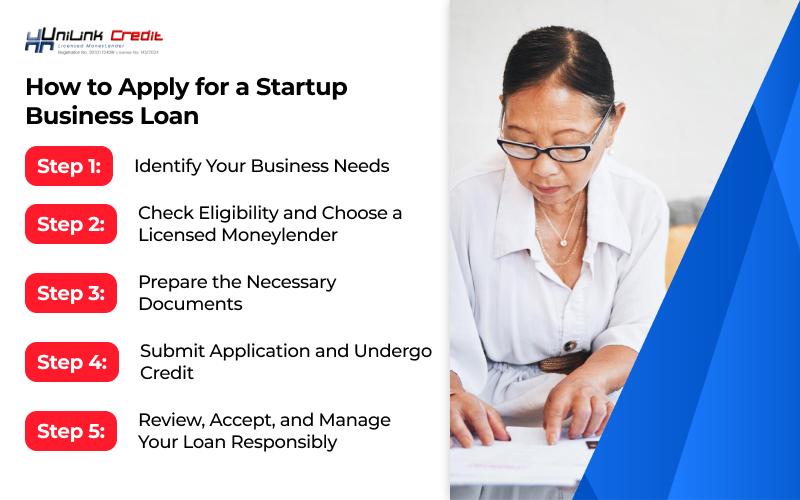
Step 1: Identify Your Business Needs
Before applying for a loan, it is important to clearly define the purpose of the funding. Businesses should determine how much capital they require and how it will be used.
The loan may be needed for several purposes, including:
- Working capital to support daily operations
- Purchasing new equipment or machinery
- Expanding business activities
- Bridging short-term cash flow gaps
Having a clear funding objective helps business owners select a loan structure and repayment plan that matches their operational needs.
Step 2: Check Eligibility and Choose a Licensed Moneylender
Entrepreneurs should ensure that their business meets the lender’s eligibility criteria before submitting an application. In Singapore, businesses must typically be registered with the Accounting and Corporate Regulatory Authority (ACRA).
Equally important is choosing a lender that operates legally. Borrowers should verify that the lender is licensed by the Ministry of Law (MinLaw). Licensed moneylenders operate within regulated frameworks that prioritise transparency and fair lending practices, giving businesses greater confidence when seeking financing.

Step 3: Prepare the Necessary Documents
A well-prepared application demonstrates professionalism and helps speed up the approval process. Businesses should organise all required documents in advance.
Common documents requested include:
- ACRA registration details
- Financial statements and recent bank statements
- NRIC or passport copies of business owners
- Supporting documents, such as contracts or cash flow projections
Providing clear and accurate documentation allows lenders to assess the business more efficiently and reduces delays during the evaluation stage.
Step 4: Submit Application and Undergo Credit Assessment
Once the required information is ready, the business proceeds with the loan application submission. Accuracy is important when completing the loan form, as incomplete or incorrect information may slow the review process.
At this stage, lenders will conduct a credit assessment to evaluate the company’s financial position and repayment capacity. This typically involves reviewing the business plan, financial records, and the applicant’s credit history. Promptly responding to any follow-up requests helps ensure that the verification process progresses smoothly.
Step 5: Review, Accept, and Manage Your Loan Responsibly
If the application is approved, borrowers should carefully review the loan terms before signing the agreement. Key details to check include the interest rate, repayment schedule, and any applicable fees.
Once the startup business loan is disbursed, funds should be used for their intended purpose. Maintaining consistent and timely repayments not only supports healthy financial management but also strengthens the business’s credit profile. As such, business owners can improve access to future financing opportunities.
Factors That Affect Startup Business Loan Approval
Lenders evaluate several financial and operational factors when assessing a startup business loan application. Understanding these considerations allows entrepreneurs to prepare stronger applications and demonstrate their ability to manage borrowed funds responsibly.
For startups exploring SME financing loans, factors such as revenue projections, business plans, repayment ability, and operational stability often influence the assessment process. Businesses seeking flexible funding support may also explore SME financing loans that cater to different stages of growth and working capital requirements through Unilink Credit’s business financing solutions.
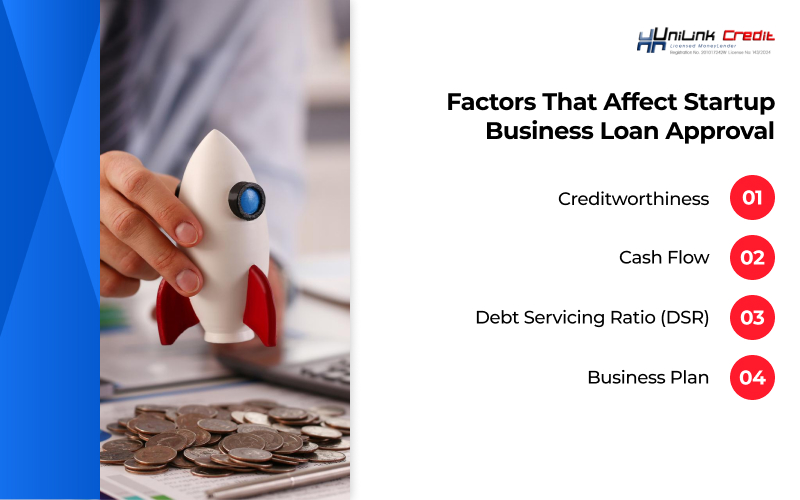
1. Creditworthiness
Creditworthiness reflects a borrower’s reliability in repaying debts. Lenders review both personal and business credit histories to evaluate financial discipline.
A strong repayment record signals that the applicant manages financial obligations responsibly. Businesses with good credit standing are generally considered lower risk, which can increase the likelihood of loan approval.
2. Cash Flow
Cash flow indicates how effectively a business generates and manages income. Lenders examine whether the company has consistent revenue streams or the potential to generate sustainable income.
Even early-stage startups can demonstrate financial potential by presenting signed client contracts, increasing sales activity, or realistic revenue projections. Stable or improving cash flow reassures the business’s strong repayment commitments.
3. Debt Servicing Ratio (DSR)
The Debt Servicing Ratio measures how much of a borrower’s income is already committed to repaying existing debts. This metric helps lenders determine whether the business has sufficient capacity to take on additional financial obligations.
A lower DSR generally indicates healthier financial management. Maintaining manageable debt levels shows lenders that the business can comfortably sustain new repayments without placing excessive strain on its finances.
4. Business Plan
A well-developed business plan is often a key factor in loan evaluation, especially when applying for a small business loan in Singapore. This document outlines the company’s goals, revenue model, target market, and growth strategy.
A realistic and well-supported plan shows that the entrepreneur has carefully considered how the business will operate and generate revenue. When lenders see a clear path toward financial sustainability, they are more confident in the borrower’s ability to repay the loan.
Why Get a Startup Business Loan from a Licensed Money Lender
For startups seeking accessible and flexible financing, regulated money lenders offer an alternative to traditional bank loans. These lenders operate under regulatory oversight and can offer tailored solutions that support the needs of small and growing businesses.
Partnering with a licensed money lender in Singapore, such as Unilink Credit, allows entrepreneurs to access financing with transparency, speed, and professional guidance.
1. Fast Approval and Flexible Financing
Traditional bank loans often involve lengthy approval processes that possibly take several weeks. For startups facing urgent financial needs, waiting this long may not always be practical.
Licensed money lenders typically provide faster approval timelines and flexible loan packages. This allows businesses to access capital quickly when opportunities or operational needs arise.
2. Transparent and Secure Borrowing
In Singapore, money lenders are regulated by the Ministry of Law (MinLaw). This regulatory oversight ensures that licensed lenders follow strict guidelines regarding interest rates, loan terms, and borrower protection.
At Unilink Credit, borrowers receive clear explanations of loan terms, transparent interest rates, and full disclosure of fees. This helps businesses make informed financial decisions without unexpected costs.
3. Personalised Support for Every Business
Every business operates differently and can face unique financial challenges. A reliable lender recognises these differences and provides financing solutions that align with each company’s operational needs.
At Unilink Credit, experienced consultants work closely with business owners to understand their financial situation. Based on this understanding, they recommend suitable loan options and flexible repayment schedules tailored to the company’s cash flow.
What are the Business Loans Offered by Unilink Credit?
Unilink Credit provides SME financing solutions designed to support businesses across different stages of growth, from newly established startups to companies managing operational expansion and short-term cash flow needs.
Whether businesses require startup capital, equipment financing, urgent operational funding, or support for day-to-day cash flow management, Unilink Credit offers financing options tailored to different business circumstances. Entrepreneurs can explore suitable loan solutions based on their operational needs, repayment capacity, and funding timelines.

Conclusion
Starting a business requires more than just a strong idea. It often requires reliable financial support to transform plans into sustainable operations. Startup business loans can provide the capital needed to cover early operational expenses and support growth opportunities. They also help businesses maintain stable cash flow during the initial stages of development.
When seeking financing, entrepreneurs should prioritise working with legal and licensed money lenders in Singapore. Unilink Credit supports startups by offering accessible financing solutions designed around the needs of growing businesses. With clear loan structures, flexible repayment arrangements, and efficient processing, we help entrepreneurs secure the capital they need with greater confidence.
If you are exploring funding options for your business, contact us to learn more about tailored startup business loan solutions.
